

UX Roll
Roles: UX Researcher / UX Designer / UI designer
Deliverable: A cryptocurrencies website
Settings: 1 man project
Timeline: 2 Weeks
Project overview
Coincube is a cryptocurrency management platform designed specifically for digital nomads and freelancers who receive payments in cryptocurrencies. The primary goal was to create an intuitive and user-friendly solution that alleviates the fear and complexity often associated with using cryptocurrencies.
Key Objectives
-
Provide a safe and secure platform for managing crypto payments received for digital work
-
Offer tailored education and guidance to demystify cryptocurrency for users new to the space
-
Enable seamless tracking, storage, and potential conversion of various cryptocurrencies
-
Deliver a delightful and engaging user experience to encourage adoption among digital nomads
What I Did:
-
Conducted qualitative research with digital nomads, gig workers, and designers to understand their cryptocurrency needs, motivations, and perceived barriers.
-
Benchmarked cryptocurrency platforms like Coinbase and investment apps like Robinhood to identify strengths in education, simplicity, and social trading features.
-
Designed a focused information architecture prioritizing key cryptocurrency tasks for digital nomads while allowing future scaling.
-
Iterated through wireframe concepts optimizing flows for managing cryptocurrency payments received for digital work.
-
Usability tested to reveal the need for clearer page status highlighting within the cryptocurrency management process.
-
Ensured web accessibility compliance (WCAG) for an inclusive cryptocurrency platform.
-
User tested a high-fidelity prototype to validate intuitive interactions and assess perceived utility among the target digital nomad users.
What I Learned:
-
Digital nomads prioritize simplicity and fear around using cryptocurrencies, requiring tailored education and guidance.
-
Benchmarked apps succeed through intuitive investing platforms, social trading, and beginner crypto education features.
-
A focused architecture eliminating unnecessary clutter is key for creating an approachable cryptocurrency experience.
-
Iterative wireframing allows optimizing unique user flows like managing freelance crypto payments received.
-
Qualitative testing highlights important status updates to maintain clarity within financial transactions.
-
WCAG compliance avoids alienating users and opens an inclusive cryptocurrency platform to a wider audience.
-
High-fidelity prototyping validates intuitive interactions and utility perceptions for the target digital nomad user base.
What I Would Do Differently:
-
Expand research to digital nomads globally to uncover potential cultural or geographic nuances.
-
Benchmark decentralized finance (DeFi) platforms for emerging features to maintain leading-edge crypto solutions.
-
Incorporate professional crypto/finance experts to vet alignment with industry regulations and best practices.
-
Explore blockchain integrations to provide enhanced security, transparency and capabilities for digital payments.
-
Invest more time refining visual design consistency and delightful micro-interactions across the user experience.
Insights and Learnings
To validate the need for a cryptocurrency management solution tailored to digital nomads, qualitative research was conducted with the target user group. The findings revealed several key pain points and challenges:
-
Fear and lack of understanding around using cryptocurrencies for receiving payments
-
Difficulty tracking, storing, and converting various cryptocurrency assets
-
Desire for a simple, intuitive platform to manage crypto payments received for digital work
Through user interviews and research, it became evident that digital nomads prioritize simplicity and approachability when it comes to managing their finances, including cryptocurrencies. A common sentiment expressed by participants was the overwhelming complexity and perceived risk associated with handling crypto payments.
As one participant stated, "I've been paid in Bitcoin a few times, but I'm always afraid of losing it or messing something up. It just seems too complicated for someone like me who isn't a tech expert."
Another participant echoed a similar sentiment: "I love the flexibility of getting paid in crypto, but keeping track of it all and figuring out how to convert it to cash is such a hassle. I wish there was an easier way to manage it."
These insights validated the need for Coincube – a platform that could demystify cryptocurrencies for digital nomads, providing them with a safe, user-friendly environment to manage their crypto payments and assets effectively.
Validation
Background
With the rapid rise in the popularity of cryptocurrencies, individuals are increasingly seeking methods and platforms to engage with the evolving digital landscape. To address this trend, quantitative research was conducted to uncover user pain points and opportunities for enhancing the user experience. This research aimed to identify key areas where improvements could be made to better serve users navigating the complexities of the digital world.


Persona
Methodology: I conducted qualitative research by recruiting participants who were comfortable with technology, likely to be part of the gig economy, and/or involved in digital design. People falling under that criteria are the users that the app is mainly focused on.

Benchmark
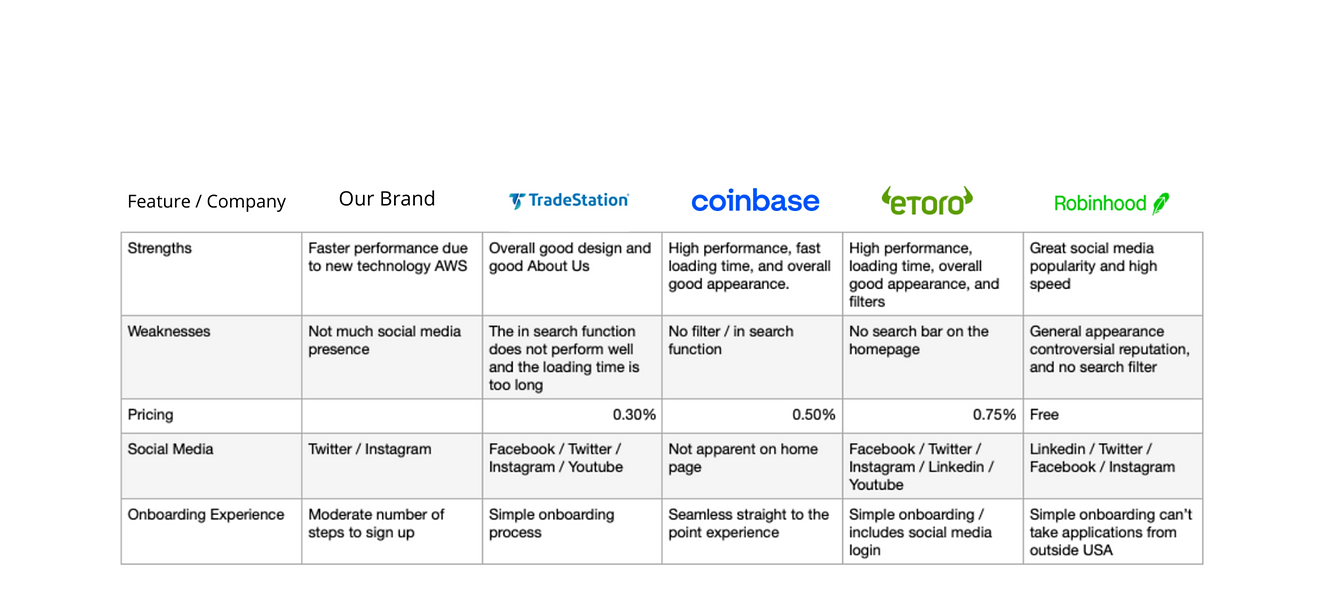
TrainStation
-
Targets amateur investors with intuitive, guided investing platform.
-
Focuses on beginner education and single assets rather than complex trading.
-
Simple, clean UIs prioritizing ease-of-use.
Coinbase
-
Largest crypto exchange catering to retail traders.
-
Charts, graphs and multiple order types create steep learning curve.
-
Security and regulation compliance is a key strength.
eToro
-
Social and copy trading differentiates platform. Ability to follow top traders.
-
Limited assets and less control over orders could constrain some traders.
-
Investing guidance and risk tools for new investors.
Robinhood
-
Leader in commission-free trading of stocks and ETFs.
-
Streamlined mobile UX and easy account setup draws younger demographic.
-
Limited customer service and educational resources. Reliability issues during peak volumes.

Information Architecture
Crafting a straightforward information architecture was crucial to enable an intuitive, user-friendly experience. I purposefully created a streamlined IA that presents only necessary content to users. This prevents overwhelming site visitors with excessive information that could hinder their ability to complete key tasks. Prioritizing simplicity provides clarity while allowing for expansion as future needs evolve.

Ideation
The ideation stage involved generating and evaluating dozens of wireframe concepts to explore multiple design directions over and over until arriving to the most intuitive design that would solve the core user journey. Through continual iteration, wireframing, and user validation, I was able to identify pain points and refine flows to craft an experience optimized for the primary conversion path.
Qualitative Usability Testing
Users were asked to use the think-out loud method during the testing while performing specific functionality tasks to track usability bugs and/or any potential pain points. An insights was gathered as a result the page status was not clear and needed to be highlighted to reflect its current status


Web Accessibility (WCAG)
.png)
Hi-Fi Prototype
User Test
The main goal of this user testing was to gather some insights as to how intuitive the interaction was, time of task completion using Typeform tasks, and a system usability scale to determine user utility perception